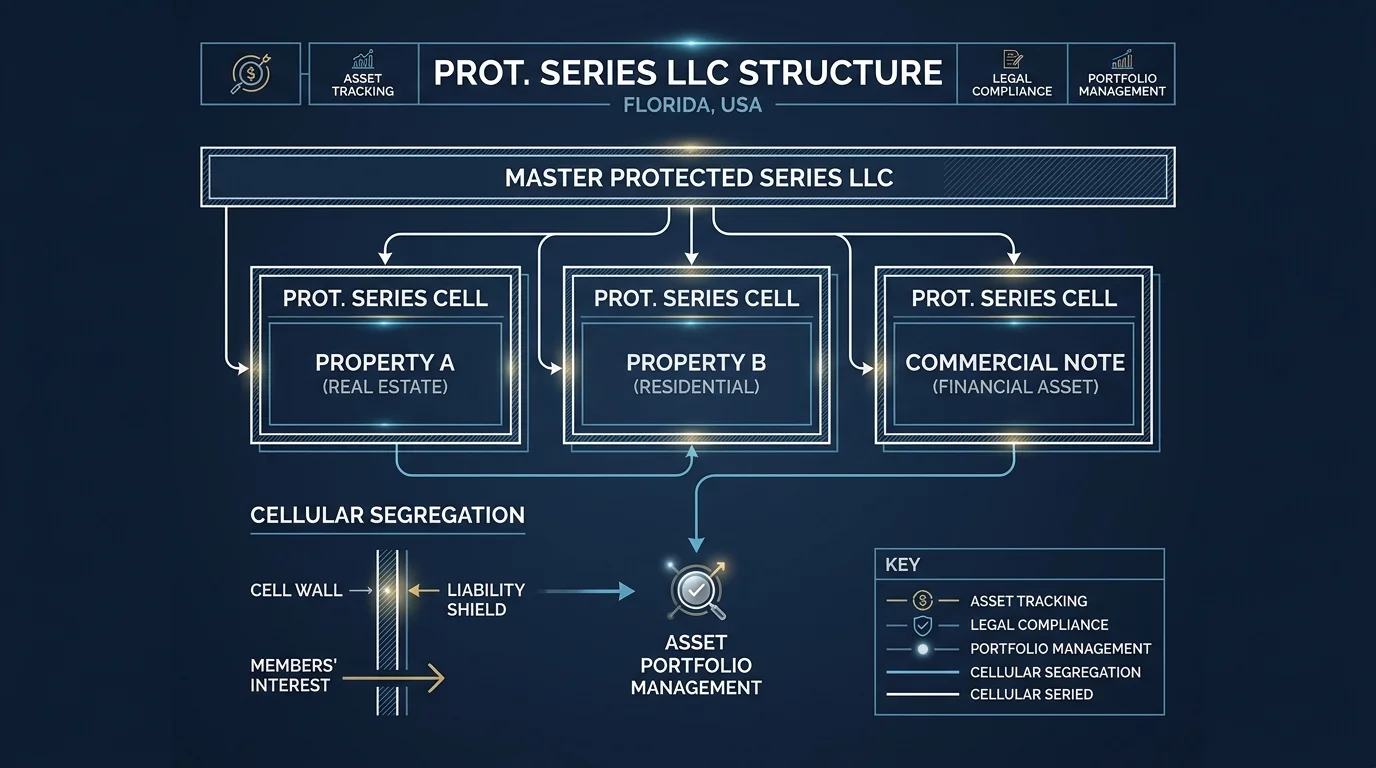
Executive Takeaway: Florida’s Protected Series LLC legislation provides commercial real estate operators and portfolio managers with an institutional holding structure previously available only through Delaware, Wyoming, or Texas domestications. Tax strategist Karlton Dennis recently analyzed this statutory milestone in his presentation, “Florida Just Changed LLCs Forever.” Dennis underscores that the horizontal liability shield is non-self-executing: enforceability in judicial proceedings requires flawless execution across five structural pillars: master LLC formation, formal Protected Series Designations, dedicated asset titling, segregated banking reconciliations, and strict contractual identification.
The Evolution of Florida LLC Law: Codifying Chapter 605 Sections 605.2101–605.2802
Real estate investors managing growing portfolios face a fundamental structural tradeoff: holding multiple properties within a single traditional LLC exposes every asset to joint liability, while creating separate standalone LLCs for each property multiplies state filing fees, registered agent expenses, annual report filings, and administrative complexity.
Historically, Florida operators seeking internal asset segregation formed series structures out-of-state—predominantly in Delaware or Wyoming—and registered them as foreign entities in Florida. However, out-of-state series structures created recurring legal friction, because Florida courts had not formally recognized internal liability partitions under Chapter 605 of the Florida Statutes.
On June 20, 2025, Governor Ron DeSantis signed CS/HB 403 (companion CS/SB 316) into law, establishing the Uniform Protected Series Provisions under Florida Statutes §§ 605.2101 through 605.2802, with an effective implementation date of July 1, 2026. This framework establishes statutory recognition for internally partitioned LLC structures formed directly inside the State of Florida.
Regulatory & Legal Advisory
Entrepreneurs Report and Curtis Waters, MBA provide strategic analysis for educational and operational planning purposes. Entity structuring, state statutory compliance, and asset protection planning require direct legal counsel. Always consult a licensed corporate attorney and certified tax professional prior to drafting operating agreements, executing property deeds, or recording entity designations.
Mechanics of the Horizontal Liability Shield: Traditional LLC vs. Protected Series LLC
To evaluate whether a Protected Series structure aligns with your investment portfolio, examine how liability partitions operate compared to traditional entity setups.
| Structural Dimension | Single Traditional Florida LLC | Multiple Standalone LLCs | Florida Protected Series LLC (2026) |
|---|---|---|---|
| Liability Exposure | Joint & commingled; a slip-and-fall at Property A jeopardizes Properties B, C, and D. | Isolated; each property sits in a distinct legal entity. | Horizontal Shield: Liabilities of Series A cannot attach to Series B, Series C, or the Parent LLC. |
| State Filing Fees & Annual Reports | Low: 1 initial filing fee ($125) and 1 annual report fee ($138.75). | High: Scaled linearly ($125 setup + $138.75/yr per entity; 10 properties = $1,387.50/yr). | Consolidated: 1 master LLC annual report plus series designation maintenance. |
| Banking & EIN Maintenance | 1 bank account, 1 EIN. | Multiple bank accounts, separate EIN for each entity, multiple tax returns. | Sub-accounts or separate accounts per series, flexible federal tax reporting. |
| Judicial Enforceability in FL | Established statutory veil. | Established statutory veil. | Explicit statutory authority under Fla. Stat. §§ 605.2101–605.2802. |
Under Section 605.2301, a debt, obligation, or other liability of a protected series is solely the debt, obligation, or liability of that specific series. It is not enforceable against the master LLC or any sibling series, provided the statutory recordkeeping and asset segregation rules are satisfied.
The 5-Part Implementation Framework: Turning Statutory Theory Into Judicial Reality
In his video analysis, “Florida Just Changed LLCs Forever,” tax strategist Karlton Dennis breaks down the architecture into five chronological components. The order of execution determines whether the liability partition withstands adversarial legal scrutiny in court or collapses into an unsegregated pool.
Part 1: The Master Operating Agreement and Articles of Organization
The structural foundation begins with forming the master Florida LLC with the Florida Department of State (Division of Corporations). The Articles of Organization and the Operating Agreement must explicitly authorize the company to establish protected series under Section 605.2101.
A standard off-the-shelf single-member LLC operating agreement will not suffice. The master agreement must delineate:
- The governance framework for creating, managing, and dissolving individual series.
- Capital contribution mechanisms from the parent entity to individual series.
- Specific fiduciary duties of managers overseeing multiple series to prevent cross-claim vulnerabilities.
- Internal voting thresholds and distribution waterfall schedules.
Part 2: The Formal Protected Series Designation Filing
Unlike older series frameworks in some jurisdictions where series could be formed purely through internal resolution, Florida’s Uniform Protected Series Act mandates public notice. Under Florida Statute § 605.2201, a master LLC establishes a protected series by delivering a Protected Series Designation statement to the Florida Department of State.
The designation statement establishes:
- The legal name of the parent Florida LLC.
- The exact legal name of the protected series.
- Compliance with Florida naming standards under § 605.2202.
Florida Protected Series Mandatory Naming Protocol (§ 605.2202):
The name of a protected series must begin with the exact legal name of the master LLC and conclude with an authorized series identifier:
[Master LLC Name], Protected Series [Identifier][Master LLC Name], P.S. [Identifier][Master LLC Name], PS [Identifier]
Example: If the master entity is Waters Capital Holdings, LLC, a compliant series holding a residential multifamily property in Tampa must be formally titled: Waters Capital Holdings, LLC, Protected Series Tampa Multifamily (or Waters Capital Holdings, LLC, PS Tampa Multifamily).
Part 3: Asset Assignment and Precise Titling
A protected series designation filed with the state is meaningless if property deeds and contracts remain titled in personal names or in the generic parent entity. To activate the horizontal shield:
- Real Property Deeds: When acquiring real estate or executing transfers, the grantee on the Warranty Deed or Special Warranty Deed must be the exact protected series (e.g., Waters Capital Holdings, LLC, Protected Series Tampa Multifamily).
- Contractual Representation: Vendor contracts, contractor agreements, and leases must explicitly state that the contracting party is the specific protected series, not the parent company or individual owner. When executing leases or managing vendors, reference our standard vendor vetting protocol to verify proper entity identification.
Part 4: Financial Segregation and Operational Accounting
Florida Statute § 605.2301 establishes that the horizontal liability shield applies only if the records of the protected series identify its assets and liabilities separately from those of the parent LLC and all other series.
The statute creates an objective test: records must be maintained with sufficient precision that an objective, disinterested third party can readily identify the specific assets, liabilities, and acquisition dates associated with that series.
- Dedicated Depository Accounts: Each series must utilize a dedicated bank account or an auditable ledger sub-account. Commingling rental collections from Property A into the operating account of Property B invites plaintiffs’ counsel to pierce the horizontal shield under Florida common-law alter-ego doctrines.
- Bookkeeping Reconciliations: Maintain separate balance sheets, profit-and-loss statements, and rent rolls for each series. Review our real estate financials mastery framework for audit-proof bookkeeping routines.
Part 5: Inter-Series Transactions and Arm’s-Length Protocol
In dynamic real estate operations, capital frequently moves between properties. If Series A generates excess cash reserves that are utilized to fund renovation draws on Series B, the transaction cannot occur as an informal electronic transfer.
Under Florida Statute § 605.2303:
- Inter-series transfers must be documented through formal written promissory notes, capital distributions, or management service agreements.
- Transactions must reflect commercially reasonable, arm’s-length terms.
- Unreconciled capital transfers between series create commingling vulnerabilities that can invalidate the entire liability shield across all compartments.
Underwriting Commercial Financing with Protected Series LLCs: The Lender’s Perspective
While Florida’s new law resolves state-level statutory ambiguity, real estate investors must account for how commercial and institutional mortgage underwriters view series entities.
Conventional vs. Non-QM & DSCR Lending
Conforming residential lenders operating under Fannie Mae and Freddie Mac guidelines generally require title to be held in natural individual names or traditional single-member LLCs, frequently declining series structures due to automated secondary market packaging constraints.
In contrast, private asset-based lenders and institutional Non-QM financiers underwrite properties based on cash flow and asset equity rather than secondary mortgage market packaging:
- DSCR Financing: Non-QM Debt Service Coverage Ratio lenders evaluate whether the subject property generates sufficient Net Operating Income to service its debt (PITIA). Many specialized DSCR lenders accommodate title held in a protected series, provided the parent entity acts as a corporate guarantor. Calculate coverage metrics with our free DSCR Calculator.
- Blanket Commercial Notes: Operators holding multiple series properties can explore cross-collateralized commercial financing. Review our guide on blanket DSCR loans to understand how portfolio notes structure liability across multiple collateral parcels.
- Hard Money Bridge Debt: Value-add acquisitions executed through a series compartment can secure rapid bridge financing. Explore our technical breakdown of hard money to DSCR refinance guidelines for seasoning requirements.
Tax Treatment: Federal Classification vs. State Level Realities
A persistent misconception among investors is that forming multiple protected series automatically triggers dozens of separate federal tax returns. The Internal Revenue Service (IRS) treats series LLCs under Proposed Treasury Regulation § 301.7701-1:
- Single-Member Master LLC: If the parent LLC is owned by a single individual (or a married couple in community property or tenancy by the entirety structures), each protected series is generally treated as a disregarded entity for federal income tax purposes unless an election is made to be taxed as an association (corporation). All rental activity rolls onto Schedule E of the owner’s individual Form 1040, eliminating separate federal tax filing fees.
- Multi-Member Master LLC: If the master LLC has multiple equity partners, the parent entity files Form 1065 (Partnership Return) with consolidated schedules, unless specific series have distinct ownership splits that necessitate separate partnership filings.
- Non-US Investors: International investors holding Florida real estate through series entities must navigate federal reporting mandates, including Form 5472 and FIRPTA rules. For cross-border structuring details, consult our comprehensive guide on creating and maintaining a US LLC for non-US owners.
Frequently Asked Questions About Florida Protected Series LLCs
Can an existing Florida LLC transition into a Protected Series LLC?
Yes. Under Florida Statutes Chapter 605, an existing Florida LLC can establish protected series by amending its operating agreement to adopt series governance provisions and submitting a formal Protected Series Designation statement with the Florida Department of State (Division of Corporations) for each newly formed series compartment.
Does each protected series receive a separate Florida document number?
Under Florida Statutes § 605.2104, a protected series is not a distinct statutory legal entity separate from its master LLC. The Florida Department of State records each Protected Series Designation under the master LLC’s primary corporate record, linking all series compartments directly to the parent organization’s annual report and registration status.
What happens if an investor commingles funds between series compartments?
Commingling operational capital between series or between a series and the master LLC violates Florida Statutes § 605.2301. In litigation, a Florida court can disregard the horizontal liability partition, allowing judgments against one asset compartment to pierce through and levy against properties held in sibling series or the master entity.
What statutory naming convention does Florida law require for protected series deeds?
Under Florida Statutes § 605.2105, the legal name of a protected series must contain the full phrase “Protected Series” or the abbreviation “P.S.” along with the exact legal name of the master LLC (for example, Sunshine Holdings, LLC – Protected Series 101). Real estate deeds and purchase contracts failing to use the full statutory moniker risk invalidating series asset isolation.
How does the IRS treat a Florida Protected Series LLC for federal income tax reporting?
For federal tax purposes under IRS Proposed Treasury Regulation § 301.7701-1, each protected series is evaluated as a separate tax entity under federal check-the-box regulations. A single-member series owned by the master LLC defaults to a disregarded entity reported on the owner’s Schedule E or Form 1065, while multi-member series are treated as standalone partnerships requiring independent EINs and Form 1065 filings.
Strategic Summary: Integrating Florida Series LLCs Into Wealth Architecture
Florida’s codification of the Uniform Protected Series Act provides real estate operators with an efficient legal framework for scaling multi-property portfolios. By replacing cumbersome webs of standalone LLCs with an integrated master series architecture, investors streamline administrative maintenance while preserving robust horizontal liability shields.
However, the durability of any asset protection structure depends on disciplined execution. Filing paperwork with the state establishes the legal framework; strict operational accounting, precise deed titling, and independent banking maintain the shield.
To review the complete commentary and video breakdown by Karlton Dennis, watch “Florida Just Changed LLCs Forever” on YouTube, and review our strategic resources on precision wealth building strategies and portfolio asset protection directories.