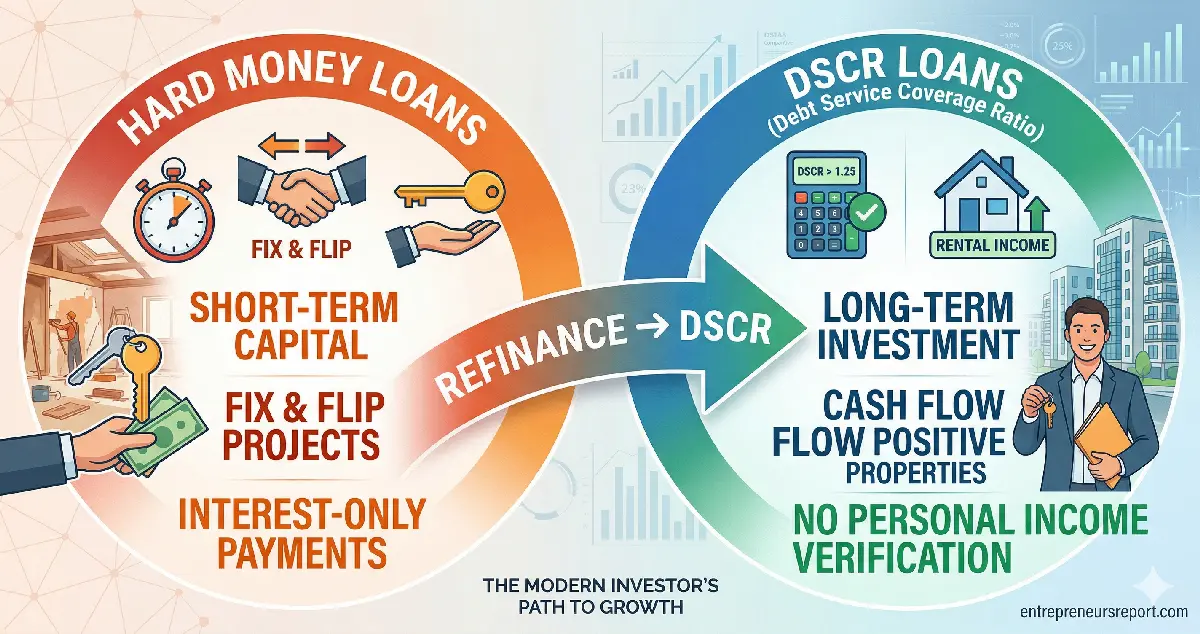
Direct Takeaway: While conventional guidelines require 6+ months, specialized Non-QM DSCR lenders process new acquisitions and cash-out refinances with 0-day (zero) seasoning. For a zero-seasoning cash-out refinance, lenders underwrite directly against the newly appraised after-repair value (ARV) upon renovation completion (typically capped at 70%–75% LTV), while rate-and-term delayed financing allows 0-month takeout up to 80% LTV of documented cost basis. Underwriting calculates debt coverage using the Fannie Mae Form 1007 Fair Market Rent Schedule.
The Bridge-to-Perm Execution Playbook for Real Estate Investors
Featured Takeaway — How Long is Seasoning for Hard Money to DSCR Refinance?: Most DSCR lenders require a 3 to 6-month seasoning period before refinancing a hard money bridge loan based on new appraised market value. If refinanced before 90 days, cash-out proceeds are generally capped at total cost basis (purchase price + documented rehab receipts) rather than current market value.
For active investors utilizing the BRRRR method (Buy, Rehab, Rent, Refinance, Repeat), short-term hard money loans provide essential transactional speed. However, bridge debt carries high interest rates (often 10%–14%) and short loan maturities (typically 6 to 18 months). Successfully exiting this expensive debt requires transitioning into a permanent, 30-year fixed-rate Debt Service Coverage Ratio (DSCR) loan.
While generic mortgage sites provide basic loan definitions, real-world deals often hit roadblocks during the underwriting transition. Understanding the mechanics of zero-seasoning programs, appraisal rent schedules (Form 1007), and entity documentation is what allows sophisticated operators to scale portfolios without getting trapped in high-interest bridge financing.
1. DSCR Seasoning Matrix: Zero-Seasoning Cash-Out vs. Standard Guidelines
Seasoning refers to how long an investor must hold title before refinancing against current market value. Progressive commercial lenders offer zero-seasoning programs to accelerate equity velocity:
| Seasoning Tier | Loan Purpose | Valuation Basis | Max LTV Cap | Underwriting Reality |
|---|---|---|---|---|
| 0 Months (Day 1 – Zero Seasoning) | New Acquisition OR Cash-Out Refinance | Full Appraised ARV (with documented rehab receipts or Non-QM value-add guidelines) | 70% – 75% | Specialized Non-QM lenders allow Day-1 cash out against newly appraised market value upon completion of property improvements. |
| 0 Months (Delayed Financing) | Delayed Financing / Rate & Term | Lesser of Total Cost Basis (Purchase + Documented Rehab) OR Appraised ARV | 75% – 80% | Immediate payoff of hard money principal right after rehab completion without pulling extra cash out. |
| 3 – 6 Months | Standard Cash-Out Refinance | Full Appraised ARV | 75% – 80% | Conventional Non-QM programs requiring established bank statement seasoning. |
2. How Lenders Calculate DSCR: Form 1007 vs. Executed Lease
The DSCR formula determines whether a property qualifies for commercial takeout financing:
$$text{DSCR} = frac{text{Gross Monthly Rental Income}}{text{Monthly PITIA (Principal + Interest + Taxes + Insurance + HOA)}}$$
Form 1007 Market Rent Appraisal Discrepancies
When an appraisal is completed on a newly renovated property, the appraiser submits Fannie Mae Form 1007 (Single Family Comparable Rent Schedule). Underwriting teams apply specific rules when comparing the appraisal to your lease:
- Vacant Property: Underwriter uses 100% of the Form 1007 Fair Market Rent. (Note: Requires Non-QM unleased guidelines with 680+ credit and max 70%–75% LTV).
- Occupied Property (Rent > Form 1007): If your signed lease is $2,200/mo but the appraiser’s 1007 schedule estimates $1,900/mo, most institutional lenders cap the qualifying income at the Form 1007 figure unless you prove 2+ months of clear rent deposits in the entity bank account.
- Occupied Property (Rent < Form 1007): Underwriters will always use the lower actual lease amount ($1,700/mo) to protect the loan file.
To calculate your exact debt coverage and stress-test loan terms across rate fluctuations, use our live DSCR Calculator.
3. Real-World Case Study: Bridge to DSCR Takeout Execution
Essential File Assembly Checklist:
- Current Bridge Loan Payoff Statement: Formal demand letter showing principal balance, per diem interest, and maturity date.
- Documented Scope of Work & Invoices: Paid contractor receipts and before/after photos proving forced capital improvement.
- Entity Corporate Records: Articles of Organization, Operating Agreement, EIN confirmation (CP 575), and Certificate of Good Standing.
- Fannie Mae Form 1007 Rent Schedule: Included with the appraisal package.
- Property Insurance Binder: Commercial policy showing LLC as Named Insured and new lender as First Mortgagee.
- Liquid Reserve Statements: 2 consecutive months showing 3 to 6 months of PITI post-closing liquidity.
Practitioner Lessons Learned: How We Avoid DSCR Underwriting Delays
Successfully transitioning from short-term bridge debt to 30-year fixed DSCR financing requires precise file preparation:
- Order Form 1007 at Application: Ensure the appraisal scope includes a market rent schedule on day one to prevent secondary underwriting delays.
- Document All Rehab Capital: Maintain itemized contractor receipts and cancelled checks to substantiate forced equity during the 90-day seasoning window.
4. Frequently Asked Questions: Hard Money to DSCR Refinance
Can you do a cash-out DSCR refinance with zero seasoning?
Yes. Certain Non-QM DSCR lenders offer Day-1 cash-out refinances based on the new appraised value (ARV) without seasoning, provided you document property improvements and meet credit requirements (typically 680–720+ FICO and 70%–75% max LTV).
Can I purchase a property with a DSCR loan without prior ownership?
Yes. DSCR acquisition loans have 0 seasoning requirements. Qualification is based on the subject property’s appraisal market rent (Form 1007) and down payment funds, without personal DTI or tax return underwriting.
What is the minimum DSCR ratio required to exit a bridge loan?
Standard pricing requires a 1.20× DSCR (property generates 20% more net rent than monthly mortgage debt). Select Non-QM programs allow 1.00× to 1.15×, and specialized “no-ratio” programs exist for strong credit borrowers (720+ FICO) at slightly higher interest rates.
Silo Integration: Scaling Your Equity Engine
Stabilizing properties with long-term DSCR debt protects your portfolio from interest rate volatility. To maximize portfolio growth, integrate your financing with our core wealth frameworks: review our Hard Money to DSCR Refinance Guide, explore Multifamily DSCR Scaling, and protect your cash flows with our Real Estate Tax Strategies Guide.
Professional Guidance from Curtis Waters, MBA
Need strategic underwriting guidance on transitioning bridge loans or scaling a residential rental portfolio across North and South Carolina? Let’s connect:
Professional LinkedIn: Curtis Waters Profile
Amazon Author: The Relationship Blueprint on Amazon
Email: curtis@entrepreneursreport.com
★ Institutional Capital Partners
✓ No Credit Check Fix & Flip Available

+
Lock In DSCR Debt, Hard Money & No-Credit-Check Rehab Financing
Underwritten against asset NOI, renovation scope, and After Repair Value (ARV) with zero W-2 or personal tax return drag. Compare Renovo Financial (institutional DSCR & bridge up to 90% LTC) and Rehab Wallet (no credit check required, up to 100% rehab budget & same-day transactional double-close funding).