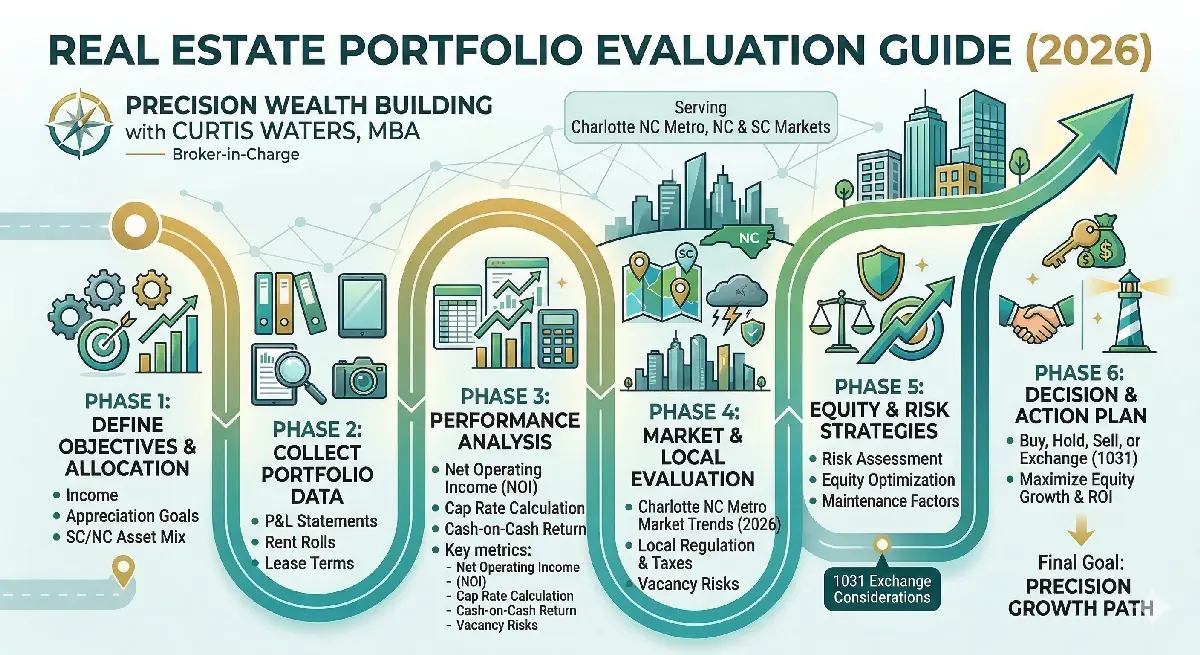
The Real Estate Portfolio Evaluation Guide: A Technical Framework
Developing a comprehensive Real Estate Portfolio Evaluation Guide is the most critical task for any investor seeking to move from accidental landlording to professional wealth management. In the data-saturated market of 2026, a “gut feeling” is no longer a viable strategy for protecting millions in equity. As a Broker-in-Charge with an MBA from the Florida Institute of Technology, I have spent 12+ years refining the audit processes contained within this Real Estate Portfolio Evaluation Guide. This technical framework is a cornerstone of the Precision Wealth Building Strategy.
The Purpose of a Technical Portfolio Audit
- Return on Equity (ROE) Calculation: ROE Formula & 50-Unit Rebalancing Guide
- Joint Venture Structuring: Finder vs. Money Partner Splits & Terms
- Residential to Commercial Migration: 1031 Consolidation into NNN Commercial
- Multifamily Benchmarking: Multifamily OER Benchmarks (20 to 80 Units)
A Real Estate Portfolio Evaluation Guide serves a singular purpose: to identify which assets are fuel for your growth and which are anchors holding you back. Many investors fail to realize that an asset that performed well five years ago may be a “toxic” drag on their current net worth due to shifting market cycles or stagnant rents. By following a structured Real Estate Portfolio Evaluation Guide, you move beyond surface-level ROI and examine the underlying efficiency of your capital. This commitment to data-driven ethics is a central theme in my book, The Relationship Blueprint.
Understanding Property Portfolio Audit Standards
To successfully optimize your real estate investments, you must execute a comprehensive property portfolio audit at least once a year. A technical property portfolio audit is different from a simple broker price opinion or tax appraisal; it is a forensic financial diagnosis of your entire capital alignment. We audit debt schedules, interest rates, capital expenditure requirements, and operational efficiency across all holdings.
How to Audit Rental Property Performance: Step-by-Step
If you want to know how to audit rental property performance, you must follow a disciplined, quantitative process:
- Reconcile the Net Operating Income (NOI): Inspect bank statements and Schedule E tax forms to confirm true historical revenues, filtering out superficial seller projections.
- Audit the Operating Expense Ratio (OER): Compare actual operating expenses against industry standards (target: 35% to 45% for residential assets) to detect expense creep.
- Calculate the Return on Equity (ROE): Determine if your capital is producing a yield that justifies the risk profile of the asset.
- Analyze Leverage and DSCR: Stress-test your loan portfolios against vacancy spikes and interest rate resets.
1. The Equity Yield Audit: Moving Beyond ROI
The first step in any Real Estate Portfolio Evaluation Guide is the Equity Yield audit. As we discussed in our analysis of ROE vs. ROI in Real Estate, Return on Equity is the “truth metric.” In this Real Estate Portfolio Evaluation Guide, we calculate the ROE for every individual asset to determine the Velocity of Wealth.
We use the following formula to identify underperforming assets within the Real Estate Portfolio Evaluation Guide:
$$ROE = frac{text{Cash Flow} + text{Principal Paydown}}{text{Current Market Value} – text{Total Debt}}$$
If an asset’s ROE falls below your target Hurdle Rate (typically 5-7% in 2026), this Real Estate Portfolio Evaluation Guide signals that it is time to harvest that equity through a 1031 Exchange. By redeploying that capital into a more efficient asset, you ensure your portfolio never suffers from Lazy Equity.
2. Risk Sensitivity and Stress Testing
A professional Real Estate Portfolio Evaluation Guide must include stress testing. We evaluate how a 1% increase in interest rates or a 10% increase in vacancy would impact your total portfolio cash flow using the Break-Even Ratio (BER):
$$BER = frac{text{Operating Expenses} + text{Debt Service}}{text{Gross Potential Income}}$$
In a high-quality Real Estate Portfolio Evaluation Guide, a BER below 75% indicates a resilient asset. If your BER exceeds 85%, your portfolio is over-leveraged and vulnerable to market corrections.
3. Operational Efficiency and NOI Optimization
The third pillar of our Real Estate Portfolio Evaluation Guide is the operational audit. We look for opportunities for forced appreciation by comparing your current expenses to industry benchmarks. If your property management fees are 10% but the market average for your asset class is 7%, this Real Estate Portfolio Evaluation Guide identifies that 3% leak as lost equity. By integrating AI-Driven Property Management, we often reduce operating expenses by 15-20%, instantly increasing capitalized asset value.
4. Leveraging Propalyze for Real-Time Analysis
To make this Real Estate Portfolio Evaluation Guide actionable, we utilize the Interactive Real Estate Investor Toolkit. It acts as the digital twin of your portfolio, pulling live data to track transitions from residential to commercial assets, monitoring your DSCR Debt Coverage and Cap Rate compression in real-time.
5. Strategic Exit and Reinvestment Roadmap
The final section of the Real Estate Portfolio Evaluation Guide is the execution plan. Once the audit is complete, we categorize every asset into three buckets:
- CORE: High-performing, efficient assets to be held long-term.
- OPTIMIZE: Assets requiring operational changes to meet the Real Estate Portfolio Evaluation Guide benchmarks.
- DISPOSE: Underperforming or lazy assets to be exchanged for higher-yielding opportunities.
Request Your Technical Portfolio Evaluation
Let’s apply this Real Estate Portfolio Evaluation Guide to your holdings. As a licensed Broker-in-Charge, I provide the precision your wealth deserves.
LinkedIn Profile: Curtis Waters, MBA
Amazon Author: The Relationship Blueprint on Amazon
Email: curtis@entrepreneursreport.com