
Core Underwriting Rule: Sellers underwrite optimism to maximize sale price; lenders underwrite audited facts to protect deployed capital. Debt Service Coverage Ratio (DSCR) lenders do not qualify notes based on projected rent increases or unverified expense cuts. Qualifying for institutional debt demands audited rental income, independent leases, and realistic operating expense ratios.
The Anatomy of Pro Forma Fiction vs. Underwriting Reality
Every commercial offering memorandum begins with a narrative: potential rent upside, untapped utility reimbursements, and normalized operating expenses. Brokers construct pro forma financial models to illustrate what an asset could earn under optimal management.
Lenders evaluate what the asset actually produced over the preceding 12 to 24 months. When submitting a loan application for non-recourse or Non-QM financing, underwriters immediately replace the seller’s pro forma statement with historical tax filings, audited bank deposits, and rent rolls. The variance between these two financial views determines whether a borrower qualifies for debt or receives an unexpected funding reduction at closing.
| Financial Component | Seller Pro Forma Model | Lender Underwriting Standard | Underwriting Impact |
|---|---|---|---|
| Gross Scheduled Rent | Top-of-market projected rents | Lower of actual in-place leases or Fannie Mae Form 1007 appraisal | Borrower must bridge equity gap if rents fall short |
| Economic Vacancy & Credit Loss | Understated at 2% to 3% | Statutory 5% to 10% underwriting floor | Directly reduces Net Operating Income (NOI) |
| Property Taxes | Historical seller tax assessment | Post-sale purchase price reassessment | Tax jumps compress cash flow and DSCR ratio |
| Repairs & Maintenance | Capital expenditures omitted or capitalized | Standard per-door minimums ($500-$900/unit/year) | Uncovers deferred maintenance liabilities |
| Property Management | Zero line item (claimed as self-managed) | Market fee added (8% to 10% of Effective Gross Income) | Ensures operational viability under third-party management |
How One Flawed Deal Destroys an Investor’s Balance Sheet
Real estate investors often assume portfolio scale provides insulation against individual property failures. In practice, commercial lending creates structural linkages that can transform one underperforming asset into an existential portfolio risk.
When an investor purchases an asset based on pro forma figures and debt service exceeds real cash flow, three systemic failures trigger:
Systemic Default Traps in Commercial Real Estate
- Cash Flow Siphon: Monthly operational deficits must be funded from cash reserves generated by performing properties, eroding liquidity across the entire enterprise.
- Blanket Loan Cross-Default: If the troubled property is bundled inside a portfolio facility or cross-collateralized commercial note, a technical default on one parcel authorizes the lender to accelerate the balance across all pledged assets. Review our technical guide on blanket DSCR loan structures to analyze cross-default mechanics.
- Secondary Market Disqualification: If an investor defaults on an institutional note, the borrower’s record enters secondary market tracking systems, terminating access to Tier 1 pricing across future acquisitions.
Physical Due Diligence: Beyond Cosmetic Walk-Throughs
Financial due diligence confirms paper records, but physical inspections determine actual capital requirements. Sellers frequently apply cosmetic renovations to common areas while deferring essential capital replacements.
An acquisition audit must inspect every single unit rather than a representative sample. In multi-tenant residential and commercial buildings, vacant units often mask severe roof leaks, disabled HVAC compressors, unpermitted plumbing alterations, or structural foundation movement.
Discovering an unpermitted building addition or secondary structure post-closing creates immediate financing complications. Lenders require appraiser verification that all living areas conform to municipal zoning. For properties with unpermitted additions, review our framework for DSCR loan appraisal guidelines on unpermitted square footage. Furthermore, before removing inspection contingencies on commercial or multifamily assets, benchmark your physical reserve model against our multifamily operating expense ratio (OER) guide.
Financial Verification and the Essential Tenant Estoppel Certificate
A rent roll is an unverified representation prepared by the seller. Leases submitted during contract negotiations reflect original signing terms, but they do not confirm that tenants are actually paying stated rent, that appliances belong to the property, or that unwritten verbal concessions are absent.
The Purpose of the Tenant Estoppel Certificate
A tenant estoppel certificate is a legally binding statement signed by the occupant confirming the exact financial terms of their tenancy. Once executed, the tenant is legally barred (estopped) from asserting contradictory claims against the new property owner.
Why the Buyer’s Team Must Procure the Estoppel Letters Directly
A frequent and dangerous mistake in commercial acquisitions is allowing the seller, their listing broker, or their property management company to distribute, collect, and summarize the tenant estoppel letters.
The seller’s financial objective during escrow is singular: getting the transaction closed at the contracted price without price concessions or retrading. If a tenant reveals unperformed maintenance, disputed deposit balances, or informal rent discounts to the seller, the seller has an inherent conflict of interest. The buyer—and only the buyer—is left holding the financial consequences of whatever due diligence was omitted once title records.
The Due Diligence Ownership Principle: You and your acquisition team must physically deliver, interview tenants for, and collect the estoppel certificates directly. When your team walks each door to secure signatures, you eliminate seller filtering, verify occupant identities against lease documentation, and hear candid feedback regarding active building defects, chronic roof leaks, or disputed charges.
A standard one or two-page tenant estoppel certificate directly collected by your team verifies five essential operational facts:
- Current Monthly Rent & Escalations: Confirms the exact base rent paid, excluding concessions, discounts, or undocumented verbal reductions granted by the seller.
- Security Deposit & Prepaid Balances: Identifies deposit amounts held by the seller, preventing disputes when tenants vacate post-acquisition.
- Lease Term & Renewal Options: Documents start and termination dates, renewal conditions, and notice requirements.
- Unperformed Landlord Obligations: Verifies whether the seller promised improvements, appliance replacements, or structural repairs that remain unfulfilled.
- Claims of Landlord Default: Requires the tenant to state whether the current owner is in breach of any lease covenants.
Direct collection prevents severe post-closing surprises, such as discovering that a key commercial tenant paid six months of rent upfront in cash to the seller without recording it, or that a tenant owns all installed appliances and expects to remove them upon lease expiration. The buyer is ultimately left with the operational and financial reality of the asset; never delegate verification to the party selling the asset.
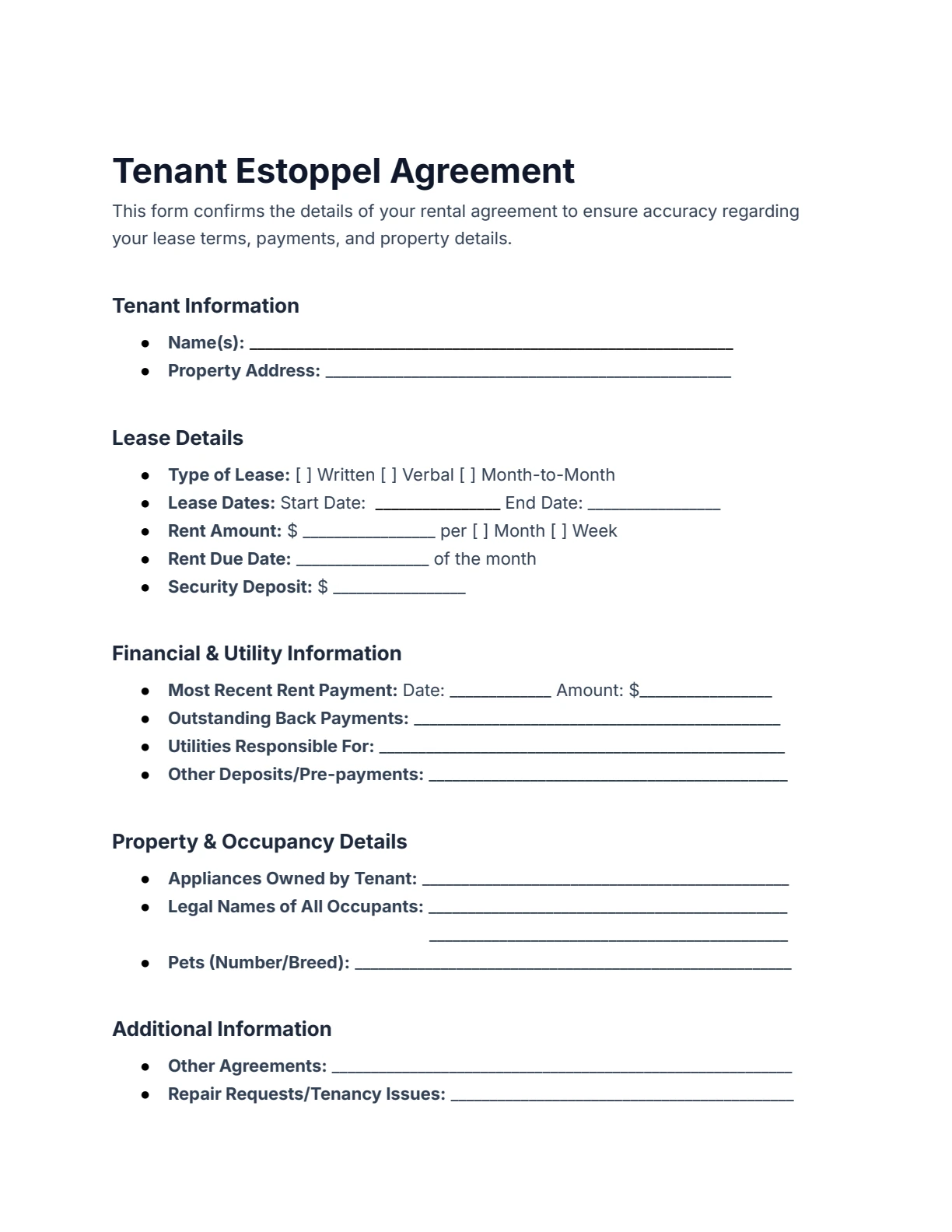
Download the 2-Page Tenant Estoppel Agreement Form
Standardize verification across your rental portfolio prior to removing contract contingencies.
Page 1: Lease & Financial Information
Page 2: Tenant & Owner Signatures
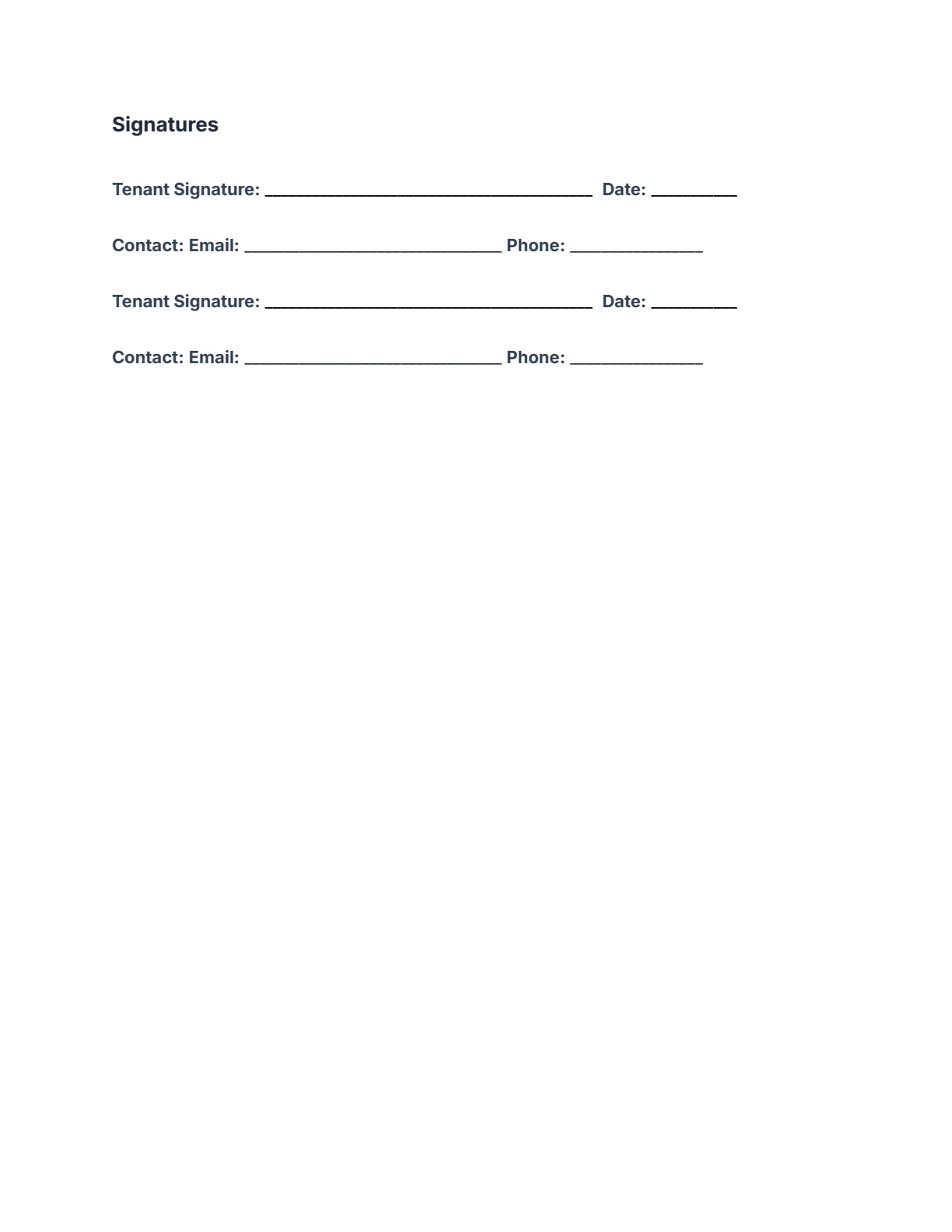
Format: Print-ready vector PDF | Size: 37.5 KB | Includes lease terms, payment history, deposit receipts, appliance ownership, and binding execution clauses.
The Property Tax Reset: Avoiding the Hidden Underwriting Deficit
The single most common mistake in pro forma financial modeling is carrying forward the seller’s historical real estate tax bill.
In many jurisdictions throughout North Carolina, South Carolina, Florida, and across the United States, county tax assessors reassess real property upon a recorded change of ownership. If the seller purchased the property a decade earlier for $400,000 and you acquire it for $1,200,000, the assessed value may triple.
Tax Reassessment Calculation: To prevent unexpected cash flow deficits, contact the local county assessor or apply the current millage rate directly to the contract purchase price before finalizing underwriting. If the annual tax obligation increases from $4,800 to $15,600, monthly escrow jumps by $900, directly reducing Net Operating Income and debt service coverage.
Direct Impact on DSCR Loan Underwriting
Debt Service Coverage Ratio (DSCR) financing evaluates the property’s ability to cover total monthly debt obligations from gross rental income:
DSCR = Gross Monthly Rental Income ÷ Total Monthly Debt Service (PITIA)
Where PITIA includes Principal, Interest, Property Taxes, Hazard/Flood Insurance, and Association Dues. Commercial and Non-QM guidelines typically require a minimum DSCR ratio between 1.20x and 1.25x for Tier 1 interest rate pricing. Learn how lenders verify cash flow in our guide to the mechanics of DSCR underwriting.
Consider how unverified pro forma assumptions alter loan approval:
Underwriting Case Study: 6-Unit Multifamily Property
Seller Pro Forma Projection:
Projected Gross Rent: $9,000/month
Historical Property Taxes: $450/month
Insurance: $350/month
Proposed Debt Service (P&I): $5,200/month
Total PITIA: $6,000/month
Pro Forma DSCR: $9,000 ÷ $6,000 = 1.50x (Strong Approval)
Lender Underwriting Reality:
Verified In-Place Rents (via Estoppels & Leases): $7,800/month
Reassessed Taxes (Post-Sale Assessment): $1,100/month
Underwritten Insurance (Current Commercial Policy): $550/month
Proposed Debt Service (P&I): $5,200/month
Actual Underwritten PITIA: $6,850/month
Realized DSCR: $7,800 ÷ $6,850 = 1.13x (Sub-1.20x Conditional Approval or Rejection)
In this scenario, relying on the seller’s pro forma causes a loan rejection or requires the borrower to bring substantial additional equity to closing to pay down principal and restore the DSCR above 1.25x.
To model debt service thresholds across fixed and adjustable financing terms, use our interactive DSCR Underwriting Calculator. If you are completing renovations under a short-term facility and preparing for take-out debt, review our comprehensive roadmap for hard money to DSCR refinance seasoning rules and Form 1007 appraisal standards, or download our DSCR stabilization and lender document preparation checklist.
Ready to Secure a DSCR or Private Capital Loan?
Access vetted balance-sheet commercial lenders for long-term DSCR term notes, ground-up construction, and bridge rehab debt. Underwrite your file against real metrics and receive institutional term sheets without retail broker markups.
Due Diligence Checklist: 7 Verifications Before Removing Loan Contingencies
- Audit the Trailing-12 Profit & Loss: Cross-reference every reported income line against 12 consecutive months of official bank statements.
- Inspect 100% of Physical Doors: Document mechanical ages, roof integrity, electrical panels, and unpermitted modifications across every unit.
- Directly Procure Tenant Estoppel Certificates: Have your team—never the seller or their broker—deliver and collect signed estoppel forms from all occupants to verify rents, deposits, and unwritten side agreements. Use our free downloadable estoppel form during physical walkthroughs.
- Calculate Post-Closing Property Taxes: Apply local millage rates to your contract acquisition price rather than relying on prior year tax receipts.
- Order an Independent Market Rent Schedule: Request Fannie Mae Form 1007 or commercial rent comparables to confirm revenue defensibility.
- Verify Municipal Code and Zoning Compliance: Ensure legal unit counts match local building records to avoid uninsurable liability.
- Confirm Underwritten DSCR with Your Lender: Verify that debt service calculations incorporate audited numbers and updated tax assessments before releasing earnest money. Submit your numbers through the Private Capital Deal Hub to verify coverage ratios.
Frequently Asked Questions
Why do lenders reject seller pro forma financials?
Lenders evaluate credit risk based on verifiable, historical performance rather than speculative revenue targets. Pro forma projections frequently underestimate vacancy, omit recurring capital replacement expenses, and inflate rental growth rates. Underwriters require audited trailing-12 statements, tax returns, and executed lease agreements.
Who is responsible for collecting tenant estoppel certificates?
While standard purchase contracts place a legal obligation on the seller to cooperate, the buyer or their dedicated management team should physically distribute, interview tenants for, and collect the completed certificates. Allowing the seller to manage the collection process introduces conflicts of interest, as sellers are motivated to smooth over discrepancies. Because the buyer inherits all lease disputes and operational deficits after closing, direct procurement ensures unvarnished verification.
What happens if a tenant refuses to sign an estoppel certificate?
Standard commercial purchase agreements require estoppel certificates from a minimum threshold of tenants (typically 80% to 100%). If an occupant refuses to sign when approached by your team, require the seller to execute a formal Seller Estoppel Certificate with specific indemnification covenants, or negotiate an escrow holdback until in-place tenancy terms and payment histories are independently proven via bank deposit records.
How does a property tax increase affect loan approval during closing?
Mortgage underwriters recalculate the monthly escrow requirement based on projected post-closing property taxes. An increased tax assessment directly increases the monthly PITIA debt payment, lowering the property’s calculated DSCR ratio. If the recalculated ratio falls below the lender’s qualifying threshold (typically 1.20x to 1.25x), the loan amount must be reduced or rejected.
Strategic Summary: Building Wealth on Verified Data
Real estate wealth is preserved through disciplined risk management and verified financial data. While optimistic pro formas offer marketing appeal, commercial lenders deploy capital only when cash flow is supported by documentation.
By verifying physical asset conditions door-by-door, auditing historical bank deposits, having your acquisition team directly procure tenant estoppel certificates, and calculating realistic post-acquisition property taxes, operators secure durable financing and protect their balance sheets against catastrophic losses. The buyer is ultimately left with the results of their due diligence.
Explore our comprehensive financing resources in the Private Capital & Deal Financing Hub to get a DSCR loan, review advanced modeling techniques in our DSCR underwriting framework, or analyze debt scenarios using the interactive DSCR calculator.