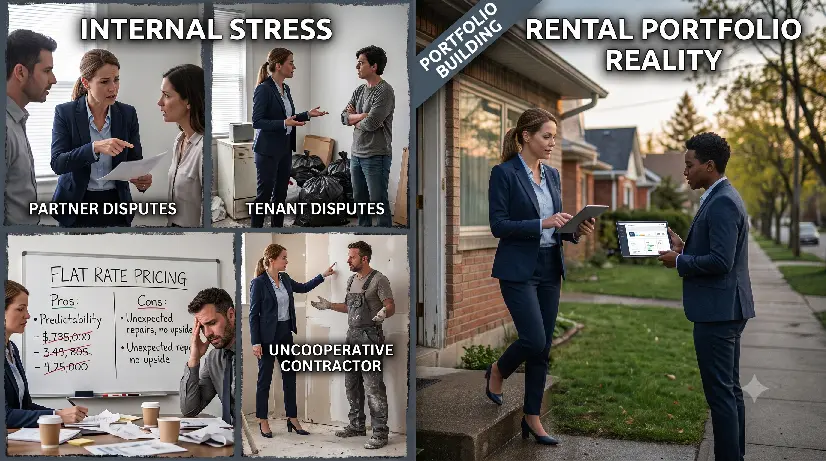
Real estate investing is fundamentally an operational discipline rather than an exercise in spreadsheet modeling. While financial calculations establish baseline numbers, negotiating contracts, resolving disputes, and executing difficult decisions drive sustainable portfolio growth. Scaling an investment portfolio requires directly confronting operational friction rather than avoiding it.
In his powerful talk, “Discomfort Is The Price of Admission to Success,” real estate expert Curtis Waters, MBA, explains this clearly. He says that your success depends on how willing you are to face hard situations. Running away from conflict does not make it go away. It only makes things worse and costs you money later. In real estate, progress is built by actively leaning into discomfort and treating it as a key indicator of growth.
To build a business that lasts, you must move from avoiding friction to actively embracing discomfort. Successful real estate operators do this every day. You must learn to lean into conflict, make hard decisions, and practice absolute honesty. This guide covers the main areas where you need to embrace discomfort to scale your portfolio.
Contractor Negotiations: Embracing Discomfort for Clear Boundaries
Working with contractors (like builders, plumbers, and painters) is one of the hardest parts of real estate. Often, they give you vague estimates or hourly rates. But you must embrace this upfront discomfort to build a professional relationship.
The Discomfort of the “Hard Conversation”
Talking to contractors about money feels awkward. Asking a builder to explain their prices or commit to a deadline feels like you are starting a fight. Many investors accept vague bids because they want to avoid this awkwardness. They tell themselves, “We will figure it out as we go.” But avoiding this talk only guarantees a worse argument later when the project runs over budget.
Why Upfront Friction Saves Your Capital
When you have the hard talk early, you set a standard of accountability. The contractor realizes you are a professional who checks their work, not someone who accepts extra costs without question. Through embracing discomfort, real estate professionals protect their project margins from silent erosion.
The Solution: The Flat-Rate Pricing Mandate
To keep things simple, enforce a strict flat-rate pricing rule before any work begins:
- Write Down the Scope of Work (SOW): Make an itemized list of every task. If it is not on the list, it does not exist.
- Use Fixed-Price Bids: Never pay by the hour for standard repairs. Make the contractor commit to a flat price for the whole project.
Tough Dialogues with Capital Partners: Embracing Absolute Transparency
Whether you raise money from partners, family, or private lenders, you must manage these relationships carefully. This requires honesty, especially when things go wrong.
The Discomfort of Operational Deviations
Projects do not always go as planned. City permits get delayed, interest rates rise, or units stay vacant. When this happens, you have to tell your investors that their money will be delayed. Telling people bad news is very hard. The temptation to stay silent or hide the problems is strong, but doing so will ruin your business.
Trust is Built in the Storm
Investors respect an operator who shares bad news honestly and quickly. When you proactively communicate problems, present the facts, and explain your plan to fix them, you build trust. By embracing discomfort, real estate managers solidify relationships and position themselves to raise more capital in the future.
The Solution: Proactive Reporting and Alignment Filters
To manage investor relationships professionally, use these rules:
- The 24-Hour Rule: If something goes wrong, tell your partners within 24 hours. Do not wait for the monthly report.
- Explain Risks Early: Before you take anyone’s money, talk about the risks. If they cannot handle a delay, do not take their cash.
- Bring a Plan: When you share bad news, always present the exact steps you are taking to resolve the issue.
Pipeline Discipline: Embracing the “No” in Deal Acquisition
When you look for properties to buy, the pressure to find a deal is very high. This pressure can cloud your judgment.
The Discomfort of Inactivity
Waiting is hard. If you have spent months making offers and getting rejected, you start to feel anxious. To escape this feeling, investors start buying bad properties just to do *something*. They accept low profits or buy properties that require too much work.
The Discipline of a Finite Resource
A bad deal is worse than no deal. It steals your time and money. Keeping your money safe in the bank is a win. By embracing discomfort, real estate professionals maintain the cash reserves necessary to buy when the right deal finally comes along.
The Solution: Strict Underwriting Boundaries
To avoid the temptation of settling, implement strict rules that take the emotion out of buying:
- Set Strict Rules: Define exactly what you want (like a minimum cash return of 20% or a DSCR of 1.2+). If a property does not meet these numbers, walk away.
- Commit to Capital Preservation: Shift your mindset. Inactivity is not failure; it is the active protection of your money until a great deal comes along.
Property Operations: Embracing the Discomfort of Accountability
Once you own properties, you have to manage them. This means keeping tenants and property managers accountable.
The Discomfort of Operational Drag
If your property manager does a bad job—like leaving units empty or ignoring repairs—firing them is stressful. For landlords who manage their own properties, enforcing rules or eviction notices is also very hard. But letting bad managers or unpaid rent slide ruins your profits.
The Solution: Professional Operations Protocols
To scale your business, you must treat accountability as a rule. By embracing discomfort, real estate owners can turn operational drag into profit through these steps:
- Active PM Goals: Set clear goals for your property manager. If they do not meet them, issue a warning and prepare to find a new firm.
- Objective Tenant Boundaries: Treat lease agreements as absolute rules. Enforce late fees automatically. Use written templates for notices so you do not make things personal.
Discomfort as Your Compass
Discomfort signals operational progression and developing capacity. Every difficult conversation expands your ability to manage a larger commercial operation.
As you scale your real estate investment business, stop viewing conflict as an obstacle. Embrace it as the price of success. The best investors are not the ones who avoid hard things, but the ones who face them head-on.
To learn more, watch Curtis Waters’ complete presentation: “Discomfort Is The Price of Admission to Success” on YouTube, and learn why embracing discomfort, real estate investors know, is a compass pointing toward growth.