Regulatory, Legal & Tax Advisory Disclaimer
This publication and its associated quantitative frameworks are provided strictly for educational, informational, and operational analysis purposes. Neither Entrepreneurs Report nor Curtis Waters, MBA is a Certified Public Accountant (CPA), licensed accountant, enrolled agent, certified financial planner, or tax attorney. Qualifying for Real Estate Professional Status (REPS) under Internal Revenue Code Section 469(c)(7) involves rigorous, fact-intensive statutory tests, complex grouping elections, and heightened IRS examination scrutiny. Federal and state tax statutes, judicial precedents, and Treasury regulations change frequently. Nothing contained herein constitutes legal, accounting, tax, investment, or financial advice. Before asserting any tax classification, grouping election, or loss deduction position on a federal or state tax return, you must consult a licensed CPA or qualified tax attorney experienced in real estate taxation within your specific jurisdiction.
The Core Statutory Mechanism: How REPS Reclassifies Rental Losses
For most real estate owners, the Internal Revenue Code establishes a default statutory barrier: under IRC Section 469(c)(2), all rental activity is classified as per se passive, regardless of the taxpayer’s operational involvement. Passive losses can only offset passive income. When an investment property generates paper losses through accelerated depreciation, debt amortization interest, repairs, or operational vacancy, those deductions cannot shelter salary, active business profits, or capital gains. Instead, they remain locked in a suspended passive loss account under IRC § 469(b), carried forward indefinitely until passive income emerges or the underlying property is disposed of in a fully taxable transaction.
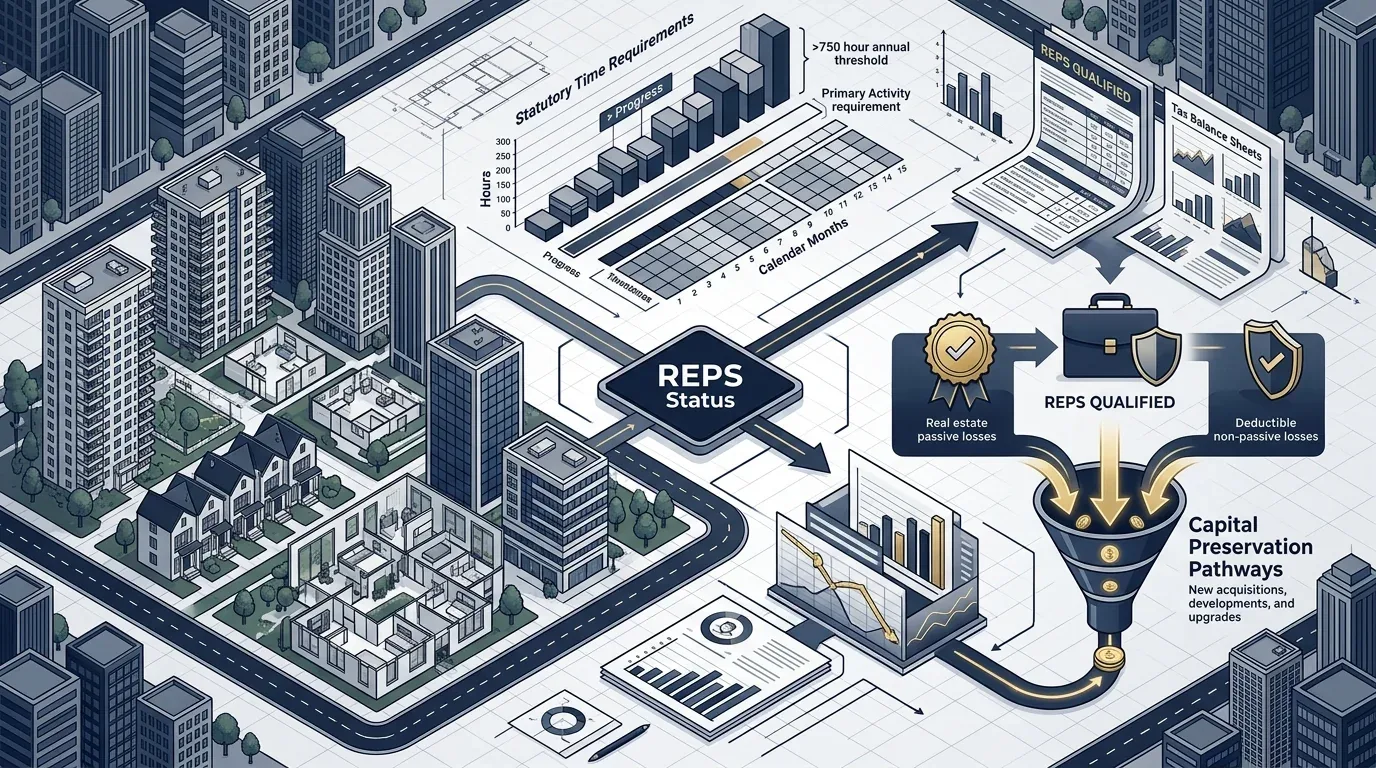
Real Estate Professional Status (REPS) removes this statutory limitation. When a taxpayer qualifies under Section 469(c)(7), the per se passive rule is lifted. Rental real estate operations in which the taxpayer materially participates are reclassified as non-passive trades or businesses. Consequently, operational losses—most notably paper depreciation unlocked through Cost Segregation studies and first-year bonus depreciation—flow through Form 1040 Schedule E to offset ordinary income from any source.
For high-income entrepreneurs, medical practitioners, corporate executives, and private equity sponsors subject to top marginal federal brackets, this classification transforms real estate from an isolated asset class into an active capital preservation structure. However, because REPS enables substantial reductions in taxable income, the IRS examines returns claiming this status with elevated scrutiny.
The Two-Part Statutory Test Under IRC § 469(c)(7)
To secure Real Estate Professional Status, an individual taxpayer must independently satisfy both prongs of a two-part statutory test during the tax year under evaluation:
Prong One: More Than Half of All Personal Services (The 50% Test)
Under IRC § 469(c)(7)(B)(i), more than 50% of the total personal services performed by the taxpayer across all trades or businesses during the taxable year must be conducted in real property trades or businesses in which the taxpayer materially participates.
This requirement presents an absolute statutory obstacle for full-time non-real estate professionals. An individual working 2,000 annual hours as a physician, technology executive, corporate attorney, or management consultant must log at least 2,001 hours in qualifying real property businesses to satisfy Prong One. Logging 800 or 1,200 hours in real estate operations fails the test because 2,000 professional hours outside real estate represents more than half of their total working time.
Prong Two: The 750-Hour Hard Floor Requirement
Under IRC § 469(c)(7)(B)(ii), the taxpayer must perform more than 750 hours of services in real property trades or businesses in which they materially participate.
The 750-hour standard is a strict statutory floor, not an approximate target. Logging 749 hours results in complete statutory failure. Furthermore, these hours must be performed within the specific tax year under audit. Hours cannot be averaged across multi-year holding periods or transferred between distinct calendar years.
| Statutory Prong | Code Reference | Legal Requirement | Disqualification Trigger |
|---|---|---|---|
| Prong 1: 50% Rule | IRC § 469(c)(7)(B)(i) | > 50% of total personal services across all businesses in real estate | Outside employment hours equal or exceed real estate hours |
| Prong 2: 750-Hour Floor | IRC § 469(c)(7)(B)(ii) | > 750 annual hours in real property trades with material participation | Logging ≤ 750 documented hours within the calendar tax year |
| Activity Standard | IRC § 469(c)(7)(C) | Services restricted to statutory real property trades or businesses | Counting investor hours (research, education, portfolio reviews) |
What Counts as a Qualifying Real Property Trade or Business
Hours only count toward the 750-hour and 50% thresholds if they are performed in one of the 11 statutory real property trades or businesses explicitly designated under IRC Section 469(c)(7)(C):
- Real property development
- Redevelopment
- Construction
- Reconstruction
- Acquisition
- Conversion
- Rental
- Operation
- Management
- Leasing
- Brokerage
Services performed as an employee in one of these 11 trades do not count toward REPS unless the employee holds at least a 5% ownership interest in the employing entity under IRC § 469(c)(7)(D)(ii). An individual working as an asset manager or leasing agent for an institutional property management firm cannot count those employee hours toward REPS unless they own at least 5% of the management business.
Material Participation & The Critical Grouping Election (Treas. Reg. § 1.469-9)
Achieving Real Estate Professional Status is only step one. Qualifying as a real estate professional under § 469(c)(7) does not automatically convert all rental properties into non-passive activities. Step two requires proving material participation in the rental real estate activities themselves.
Under Treasury Regulation § 1.469-5T, a taxpayer must satisfy at least one of seven quantitative material participation tests for the rental activity:
- Test 1 (The 500-Hour Standard): The taxpayer participates in the activity for more than 500 hours during the tax year.
- Test 2 (Substantially All Participation): The taxpayer’s participation constitutes substantially all of the participation of all individuals (including non-owners and third parties) in the activity.
- Test 3 (Significant Participation): The taxpayer participates for more than 100 hours, and no other individual participates more than the taxpayer.
- Test 4 (Significant Participation Activities Aggregation): The activity is a significant participation activity (>100 hours), and aggregate participation across all SPAs exceeds 500 hours.
- Test 5 (Historical Participation): The taxpayer materially participated in the activity for any 5 of the preceding 10 taxable years.
- Test 6 (Personal Service Activity): The activity is a personal service activity in which the taxpayer materially participated for any 3 prior tax years.
- Test 7 (Facts and Circumstances): Based on all facts and circumstances, the taxpayer participates on a regular, continuous, and substantial basis (requiring a minimum of 100 hours).
Without this formal grouping election, an investor who logs 900 total hours across a portfolio of 10 rental properties (90 hours per asset) satisfies the 750-hour REPS test, but fails material participation on every individual property under Test 1. Consequently, all rental losses remain passive. Executing the Treas. Reg. § 1.469-9(g) election unites the 10 assets into a single activity, allowing the 900 hours to satisfy Test 1 across the entire portfolio simultaneously.
The Spouse Non-Aggregation Rule on Joint Returns
For married taxpayers filing jointly, statutory qualification under Section 469(c)(7) must be established by one spouse independently:
This dynamic forms the foundation of real estate wealth planning for married couples. When one spouse earns substantial W-2 or business income in a demanding corporate or medical field, the second spouse can manage the real estate portfolio full-time. Provided the managing spouse logs 751+ hours and satisfies the 50% rule, their REPS qualification applies to the joint return, allowing accelerated depreciation deductions to shelter the non-real estate spouse’s high-bracket income.
Contemporaneous Time Tracking & IRS Audit Defense
The vast majority of Real Estate Professional Status cases litigated in the United States Tax Court are decided on evidentiary substantiation rather than statutory interpretation. Under Treas. Reg. § 1.469-5T(f)(4), taxpayers may establish participation by any reasonable means. However, the Tax Court routinely rejects post-audit approximations, retrospective calendar estimates, and uncorroborated testimony.
Tax Court Precedents: The Hazard of Reconstructed Logs
In landmark Tax Court decisions such as Moss v. Commissioner (135 T.C. 365) and Hafiz v. Commissioner (T.C. Memo. 2012-101), the court systematically disallowed claimed REPS hours where taxpayers attempted to reconstruct time logs months or years after the operational period using bank statements, utility invoices, and phone records. The court characterizes retrospective estimates as unpersuasive post-hoc rationalizations.
Permissible Operational Hours vs. Disallowed Investor Time
The IRS Passive Activity Loss Audit Technique Guide (ATG) instructs revenue agents to exclude specific categories of time from the 750-hour calculation:
- Disallowed Investor Activities (Treas. Reg. § 1.469-5T(f)(2)(ii)): Reviewing financial statements, organizing records, analyzing market reports, and reading industry trade news do not count unless the taxpayer is directly involved in day-to-day property operations.
- General Education & Travel: Attending seminars, educational courses, and commuting to properties without documented operational duties are routinely struck down.
- Direct Operational Activities (Fully Permissible): On-site property inspections, tenant lease negotiations, direct tenant communication, supervising third-party contractors, procuring materials, handling maintenance emergencies, and physical turnover management.
The $25,000 Active Participation Allowance: A Separate Rule
Taxpayers who do not qualify as Real Estate Professionals may still deduct up to $25,000 in rental real estate losses under IRC Section 469(i). However, this allowance operates under fundamentally different statutory mechanisms:
Asset Disposition & Release of Suspended Losses (IRC § 469(g))
When an investment property is sold in a fully taxable transaction to an unrelated third party, all suspended passive losses tied to that specific asset are released under IRC Section 469(g). Released losses first offset gain from the disposition, then net passive income from other activities, and finally flow through to offset ordinary non-passive income.
However, investors who have executed a Treas. Reg. § 1.469-9 grouping election must exercise extreme caution. Because all rental properties are treated as a single unified activity, selling one property from a grouped portfolio of 10 assets does not represent a complete disposition of the activity. Under Treasury regulations, suspended losses cannot be freed at the time of sale unless the taxpayer disposes of substantially all of the unified activity or can establish with reasonable certainty the specific losses allocable to the disposed asset.
To defer depreciation recapture and capital gains when exiting assets, operators frequently combine REPS holding strategies with IRC § 1031 tax-deferred exchanges, utilizing our interactive Cost Segregation & 1031 Exchange Chain Calculator to project cumulative basis roll-forwards.
Frequently Asked Questions About Real Estate Professional Status
Can a W-2 employee with a full-time job qualify for Real Estate Professional Status?
Statutorily, yes; practically, it is exceptionally rare and heavily audited. Under IRC § 469(c)(7)(B)(i), the taxpayer must work more hours in real estate than in all other professional activities combined. A taxpayer working a standard 2,000-hour W-2 corporate job must log at least 2,001 documented hours in qualifying real property businesses—requiring an aggregate of 4,001 annual working hours (over 76 hours every week of the year). The IRS and Tax Court view such assertions with extreme skepticism.
What is the difference between active participation and material participation?
Active participation is a lower standard under IRC § 469(i) requiring only bona fide involvement in management decisions (such as approving lease terms, rental rates, and repair expenditures) and at least 10% property ownership. It unlocks the phased-out $25,000 rental loss deduction. Material participation under Treas. Reg. § 1.469-5T is a rigorous, quantitative test (typically requiring 500 annual hours) that determines whether an activity is non-passive once REPS qualification is established.
Can you make the Treas. Reg. § 1.469-9 grouping election retroactively?
No. The aggregation election must be filed affirmatively with an original, timely filed Form 1040 for the tax year in which it is first intended to apply. While the IRS provides relief under Revenue Procedure 2011-34 for taxpayers who inadvertently omitted the statement, granting relief requires proving reasonable cause and meeting strict procedural guidelines. The election cannot simply be asserted during an audit exam.
Does hiring a professional property management company disqualify an investor from REPS?
Hiring a third-party property management company does not automatically disqualify an investor from achieving REPS, but it makes satisfying material participation on rental properties substantially more difficult. When a third-party manager handles daily tenant calls, leasing, and repairs, the owner cannot claim those operational hours. The owner must prove they still independently contributed more than 500 hours or more hours than the management company personnel under Treas. Reg. § 1.469-5T.
How does Real Estate Professional Status interact with commercial debt underwriting?
Commercial and private mortgage lenders underwrite loans based on global cash flow and debt service coverage. While REPS reduces personal taxable income on Form 1040, sophisticated underwriters evaluate Debt Service Coverage Ratio (DSCR) by adding back non-cash paper deductions (such as depreciation and amortization) to Net Operating Income, preserving the borrower’s commercial borrowing capacity.
Horizontal Silo Integration: Scaling Real Estate Tax Architecture
Real Estate Professional Status represents one component of an integrated real estate wealth framework. To maximize tax efficiency, institutional capital preservation, and portfolio velocity:
- Accelerate Paper Deductions: Coordinate REPS with engineered Cost Segregation Studies to front-load depreciation into 5-, 7-, and 15-year property classes.
- Model Cumulative Basis Roll-Forwards: Utilize our interactive Cost Segregation & 1031 Exchange Chain Calculator to simulate multi-asset tax deferral.
- Structure Institutional Liability Shields: Segregate real estate holdings into compliant asset compartments via the Florida Protected Series LLC framework.
- Ensure Cross-Border Compliance: If deploying foreign equity, review compliance mandates for US LLCs with Non-US Owners.
- Protect Retirement Capital: Compare taxable REPS strategies with tax-free alternative investing under SDIRA Prohibited Transactions Compliance.
- Explore the Central Knowledge Base: Review our comprehensive Tax & Compliance Hub for regulatory guidelines and operational toolkits.