Institutional Underwriting Reality: While conventional banking channels impose rigid 6-to-12 month seasoning rules, specialized Non-QM DSCR lenders offer 0-day / zero-seasoning programs for both new acquisitions and cash-out refinances. On a zero-seasoning cash-out refinance, institutional DSCR lenders underwrite directly against the newly appraised market value (ARV)—allowing immediate equity extraction upon renovation completion without waiting through arbitrary holding periods (typically up to 70%–75% LTV with 680+ FICO).
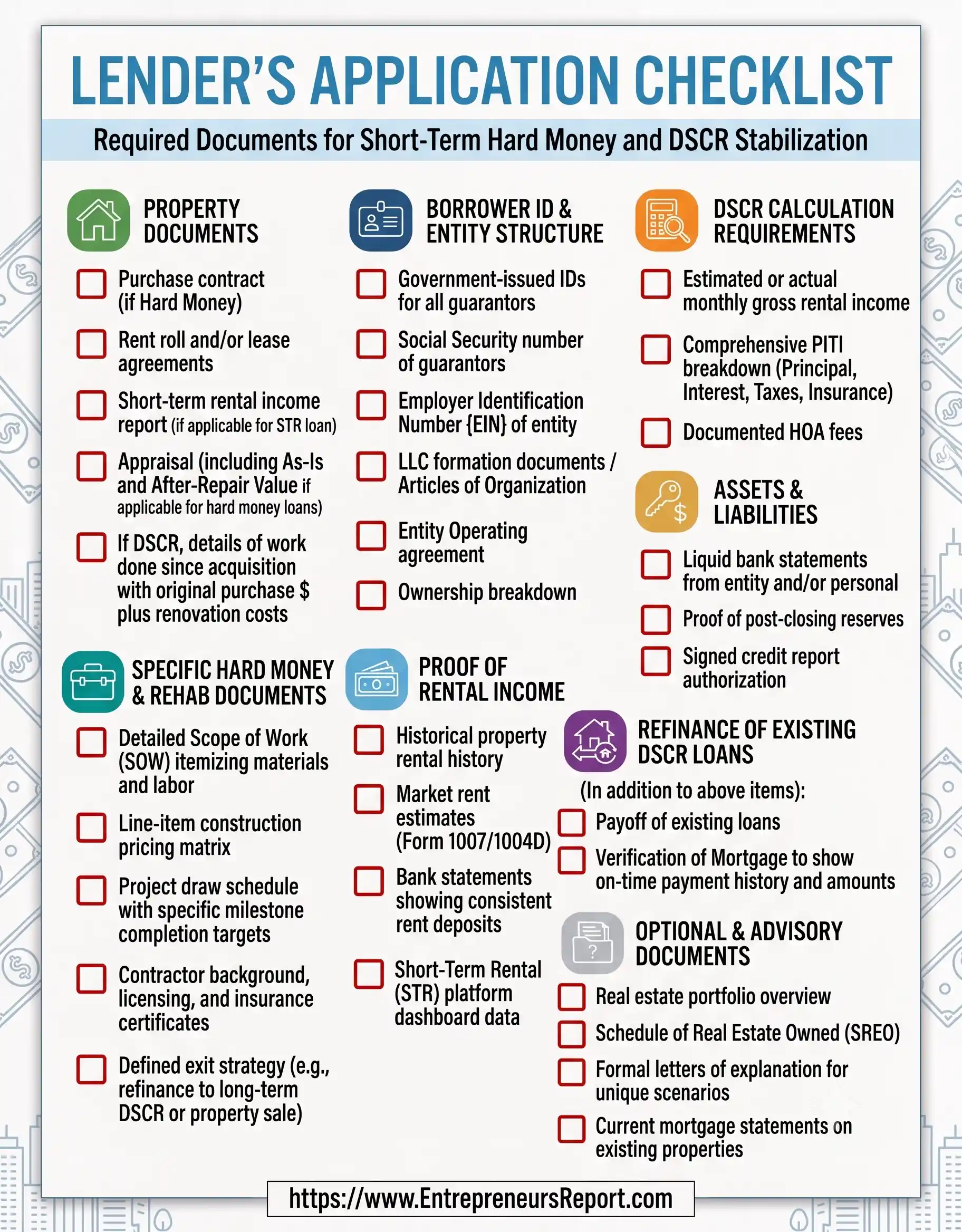
Navigating the closing process for institutional property financing requires a systematic approach to asset verification. When preparing a commercial file, organizing your DSCR stabilization and hard money takeout documents efficiently allows you to bypass the traditional paperwork drag of conventional lending channels. As detailed in our master directory on the Entrepreneurs Report homepage, eliminating personal tax returns, W-2 forms, and debt-to-income (DTI) calculations shifts the lender’s underwriting focus entirely to property-level Net Operating Income (NOI) and borrowing entity compliance.
Because these loans are strictly commercial facilities executed in the name of a business entity (LLC, LP, or Corporation), file preparation must be clinically precise. Utilizing a formalized protocol for collecting corporate documents, title records, and rent schedules prevents processing friction, shields your bridge loan maturity dates, and signals institutional sophistication to tier-one capital partners.
Institutional Loan Preparation Toolkit
Download the compliant structuring templates and verified underwriting checklists required by commercial division underwriters to clear your files rapidly:
1. DSCR Seasoning Matrix: Zero-Seasoning Cash-Out vs. Standard Guidelines
Understanding which lenders offer zero-seasoning options allows BRRRR operators and portfolio builders to recycle acquisition capital instantly rather than letting equity sit dormant:
| Seasoning Tier | Loan Purpose | Valuation Basis | Max LTV | Lender Program Guidelines |
|---|---|---|---|---|
| 0 Months (Day 1 – Zero Seasoning) | New Acquisition OR Cash-Out Refinance | Full Appraised ARV (with documented rehab receipts or Non-QM value-add guidelines) | 70% – 75% | Progressive Non-QM lenders allow immediate cash-out against new market value on Day 1 upon rehab completion. |
| 0 Months (Delayed Financing) | Rate & Term Bridge Payoff | Lesser of Total Cost (Purchase + Verified Rehab) OR ARV | 75% – 80% | Standard takeout for immediate hard money debt replacement without pulling additional cash out. |
| 3 – 6 Months | Standard Cash-Out Refinance | Full Appraised ARV | 75% – 80% | Traditional Non-QM guidelines requiring established rent history on bank statements. |
2. Zero-Seasoning Underwriting for Acquisitions and Fast Cash-Outs
For investors actively executing heavy renovations, waiting 6 months to pull out capital severely suppresses compounding velocity. Zero-seasoning DSCR programs unlock two vital funding channels:
A. New Acquisitions (0-Day Ownership Requirement)
You can purchase residential rentals (1–4 units) and commercial multifamily assets with a DSCR loan from Day 1. There is no requirement of prior property ownership history. Underwriting evaluates the purchase price, your down payment liquidity (typically 20%–25%), and the projected market rent generated by the appraisal inspection (Form 1007).
B. No-Seasoning Cash-Out Refinances (Immediate Capital Extraction)
When refinancing out of a short-term hard money or private bridge loan, zero-seasoning DSCR lenders allow you to borrow against the new appraised value (ARV) immediately. To clear underwriting without seasoning friction, ensure your file contains:
- Itemized Contractor Invoices & Proof of Payment: Documenting the capital expenditure that created the forced appreciation.
- Before-and-After Photo Schedule: Demonstrating the physical transformation to the desk appraiser.
- Fannie Mae Form 1007 Rent Schedule: Proving the newly elevated fair market rental rate.
3. Entity Requirements for DSCR Stabilization Files
Closing a loan under a corporate structure provides essential liability separation, but it demands absolute compliance with corporate filing standards. Lenders accept entity vesting from day one, but their underwriting teams must verify that the entity is legally sound and authorized to incur mortgage debt:
- Articles of Organization / Certificate of Formation: The formal, state-issued document establishing your LLC with official state stamp.
- Entity Operating Agreement: A fully executed agreement signed by all members confirming ownership percentages and identifying who holds authorized signing power.
- EIN Confirmation Letter: IRS-issued tax identification verification (Form CP 575 or Form 147C).
- Certificate of Good Standing: Required for any entity formed over 12 months prior, proving current state tax and filing compliance.
- Foreign Entity Registration: Mandatory if your entity is formed out-of-state (e.g., Wyoming or Delaware LLC) while the real estate asset is located in NC, SC, or another state jurisdiction.
- Borrowing Resolution: A unanimous consent document signed by members explicitly authorizing the debt amount and designating a managing member to execute closing instruments.
4. Personal Guarantor & Asset Verification Guardrails
Even though the LLC is the legal borrower, institutional guidelines require a personal guarantee from anyone holding 20% to 25% or more equity within the borrowing entity:
- Government-Issued Photo ID: Clear unexpired passport or driver’s license for all 20%+ equity holders.
- Credit Authorization: Signed authorization for standard tri-merge credit pull (mid-FICO score heavily influences pricing tier and minimum DSCR thresholds).
- Liquid Bank Statements: 2 most recent consecutive months of bank statements proving source of down payment, closing costs, and origination points.
- Proof of Post-Closing Reserves: Verification of 3 to 6 months of Principal, Interest, Taxes, and Insurance (PITI) reserves held in liquid accounts post-closing.
5. Property Performance & Form 1007 Rent Valuation
Underwriting centers around the debt coverage formula. For a complete mathematical breakdown of how underwriters evaluate Gross Rental Income versus Debt Service, review The Complete Mechanics of Debt Service Coverage Ratio Underwriting.
Key property-level documentation items include:
- Fannie Mae Form 1007 Rent Schedule: Ordered alongside the appraisal to establish fair market rent. If the property is vacant, the underwriter uses the 1007 appraiser figure. If occupied, lenders generally take the lesser of actual lease rent or Form 1007 market rent.
- Executed Lease Agreement & Security Deposit Proof: Required for occupied assets along with matching bank records.
- Property Hazard & Flood Insurance Binder: Must list the borrowing LLC as Named Insured and the lender as First Loss Payee / Mortgagee.
- Hard Money Payoff Statement: Formal demand payoff letter from your existing bridge lender specifying per diem interest through closing.
6. Frequently Asked Questions: No-Seasoning DSCR Financing
Are there DSCR lenders that process cash-out refinances with zero seasoning?
Yes. Multiple specialized Non-QM commercial lenders offer zero-seasoning (0-day) cash-out refinances based on the newly appraised market value (ARV) immediately upon renovation completion, provided the borrower provides documented rehab invoices and maintains strong credit (typically 680–720+ FICO with max 70%–75% LTV).
Can I purchase a property with a DSCR loan without any seasoning or prior ownership?
Yes. DSCR acquisition loans require zero seasoning. The lender qualifies the deal entirely on the property’s market rent (via appraisal Form 1007) and the buyer’s down payment liquidity, without examining personal W-2 income or tax returns.
How do lenders calculate DSCR on a newly renovated vacant property?
Lenders order an independent Fannie Mae Form 1007 Single Family Comparable Rent Schedule during the appraisal inspection. The appraiser’s estimated market rent is used as the gross income figure in the DSCR formula: DSCR = Gross Market Rent / Monthly PITIA.
★ Institutional Capital Partners
✓ No Credit Check Fix & Flip Available
+
Lock In DSCR Debt, Hard Money & No-Credit-Check Rehab Financing
Underwritten against asset NOI, renovation scope, and After Repair Value (ARV) with zero W-2 or personal tax return drag. Compare Renovo Financial (institutional DSCR & bridge up to 90% LTC) and Rehab Wallet (no credit check required, up to 100% rehab budget & same-day transactional double-close funding).
7. Horizontal Silo Integration: Tax & Portfolio Growth
Securing predictable, fixed-rate DSCR debt allows you to permanently stabilize assets and unlock capital velocity. However, cash flow must be defended against tax drag. To align your financing with proactive tax mitigation, consult our guides on Real Estate Tax Strategies: Cost Segregation & Recapture and structured 1031 Exchange Strategies. For scaling multifamily portfolios beyond residential scales, review our masterclass on DSCR Loans for Multifamily: Scaling to 100+ Units.