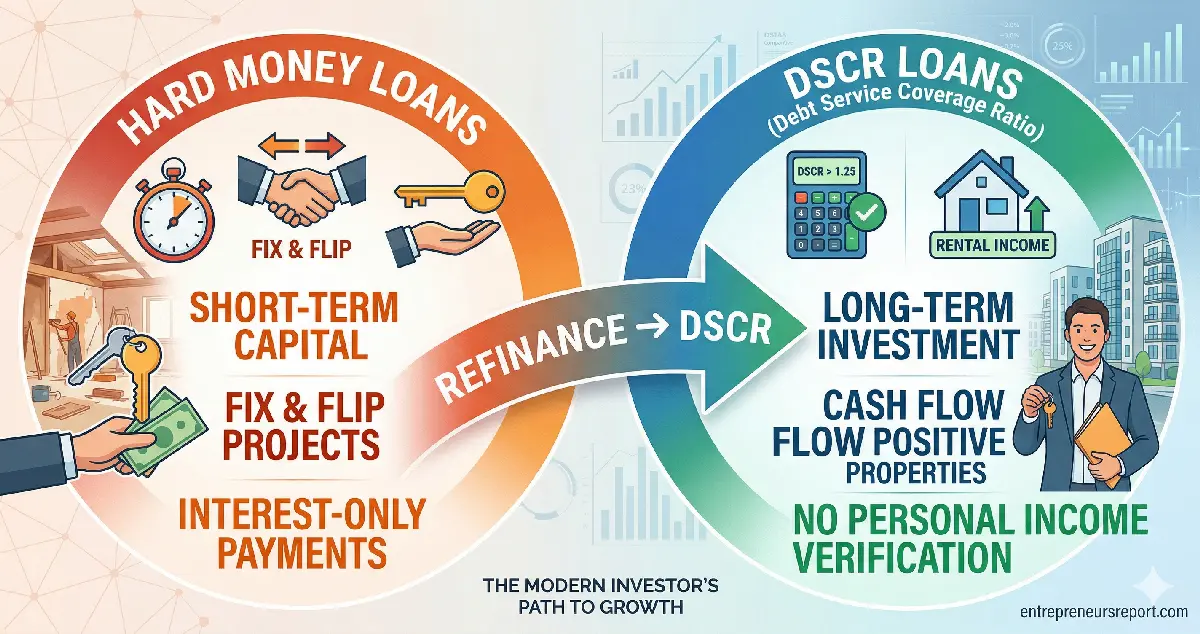
For the modern real estate entrepreneur, speed is everything. Hard money allows you to move fast on distressed assets, but the high interest rates and short terms make an exit strategy essential. The most effective path to long-term wealth is the transition from Hard Money to a DSCR (Debt Service Coverage Ratio) loan.
The transition from hard money to DSCR is not only strategic but essential for maximizing your investment potential. This bridge-to-permanent strategy allows you to stabilize a property, pull out your initial capital, and lock in a 30-year fixed rate based on the property’s performance rather than your personal income.
The 4-Stage Hard Money to DSCR Refinance Process
To ensure a successful transition, we break the analysis down into four critical stages. Before starting, calculate your projected numbers using our interactive DSCR Calculator to verify that your exit parameters are sound.
Stage 1: The Acquisition and Rehab Phase
Your exit strategy begins the day you buy the property. You must account for the purchase price, renovation costs, and the specific terms of your hard money loan. Lenders typically lend based on After-Repair Value (ARV), and your total capital exposure during this phase determines how much equity you can eventually pull out.
Stage 2: DSCR Refinance Evaluation
Once the renovation is complete and a tenant is in place (or the property is ready for market), we evaluate the property as a long-term asset. The lender will calculate the DSCR PITI payment to ensure the rental income covers the new mortgage, taxes, and insurance. Aiming for a ratio of 1.25 or higher ensures you access the most competitive rates. To structure your compliance assets beforehand, review our technical guide on tracking your necessary DSCR stabilization and hard money documents.
By opting for a hard money to DSCR refinance, you position yourself for long-term financial success.
Stage 3: Analyzing Refinance Costs
Don’t let junk fees eat your profits. This stage involves a deep dive into lender charges, including points, processing fees, and appraisal costs. Estimating these net proceeds accurately is vital to understanding your liquidity position post-closing.
Stage 4: Summary of Equity
The final step is aggregating all costs—from the initial hard money points to the final DSCR closing costs—to determine your remaining equity. If executed correctly, this is where you wash your capital, allowing you to move onto your next acquisition.
Understanding the hard money to DSCR process can significantly impact your investment outcomes.
Common Challenges in the Refinance Market
- Seasoning Requirements: Some lenders require you to hold the property for 3–6 months before refinancing based on the new ARV.
- Appraisal Lag: In a stabilizing market, ensure your rehab adds enough functional value to meet your target DSCR ratio.
- Timing: If your BRRRR process takes a long time, the comparable values that the appraiser sees between your hard money request and subsequent DSCR appraisal might have shifted out of your favor. Plan for this contingency.
- Valuation: It is vital in these cases to know your numbers. Knowledge of the following items will provide the visibility you need in order to keep the financials straight:
- Hard Money Loan Points
- Hard Money Appraisal Costs
- Hard Money Loan Admin Fees
- Initial insurance (Builders Risk if no tenant)
- Initial Purchase Closing costs
- Carrying costs (Monthly loan interest, initial cash needed to fund initial loan draw, property utilities)
- DSCR Appraisal Costs
- DSCR Points
- DSCR Loan Admin Fees
- DSCR Loan Escrow amounts required by lender
- DSCR Lender reserves in excess to escrow amounts
- DSCR Loan closing costs
Perhaps you or you and a partner planned to buy a property with a hard money loan, and then transition to a DSCR loan and recoup all your funds. This looks doable—until you see the points involved, appraisals, closing fees, and monthly interest costs. Proper planning can provide some assurance regarding the premise of getting your funds out of the project. Ultimately, the shift from hard money to DSCR will determine your ability to scale your real estate portfolio.
Conclusion: Scaling with Confidence
Transitioning from Hard Money to DSCR is the engine of the BRRRR method. By mastering this 4-stage process, you move from a high-risk short-term position to a stable, cash-flowing asset that builds generational wealth. For institutional-grade strategies to accelerate this pipeline, check our DSCR Loans Multifamily Masterclass.
Mastering the hard money to DSCR transition is crucial for sustainable growth.